
Moving to Boise, Idaho: What You Need to Know
Last updated: September 2026
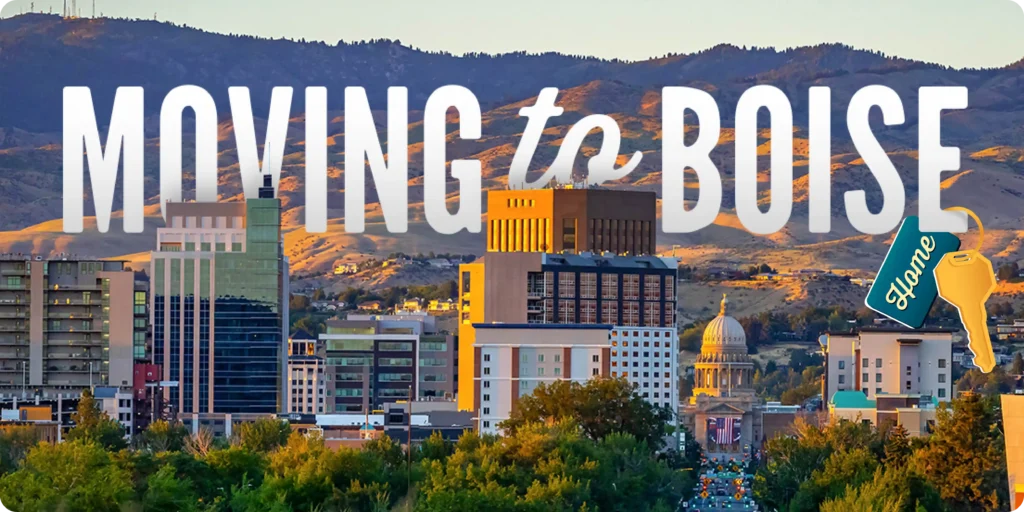
Idaho’s capital city offers a mix of desirable features that can be difficult to find in one place. If you’re moving to Boise, you’ll discover a solid job market, metropolitan conveniences and entertainment married with easy access to parks, rivers, trails, mountains and public land. This combination appeals to families, professionals and retirees alike.
Facts and statistics can only tell you so much about what it’s like to live in Boise. To give you a clearer picture, we also asked several Horizon team members from the area what it’s like to live there. Their answers offer a firsthand look at the local character, opportunities and changes shaping life in the Treasure Valley.
Boise at a glance
| Population | Approximately 238,429 |
| Median household income | $83,904 |
| Median home value | $484,800 |
| Median gross rent | $1,446 |
| Average commute time | 18.9 minutes |
| State | Idaho |
| Nickname | City of Trees |
Source: U.S. Census Bureau QuickFacts for Boise City, Idaho (2026)
Why are people moving to Boise?
Ask 10 Boise residents why they live here and you’ll probably get 10 different answers. Some will talk about the outdoor lifestyle. Others will point to career opportunities, family-friendly activities or a sense of community that can be hard to find in larger cities.
For John Cotner, Horizon’s vice president of lending, the appeal comes from a combination of those qualities. He describes Boise as having “big city amenities, but still a small-town feel,” along with “incredible access to most any kind of recreation.”
That balance comes up frequently when locals talk about Boise. The area continues to grow, but the city still feels approachable. Restaurants, shops, entertainment and outdoor recreation are all easily accessible for anybody living in the larger metro area.
Boise is the center of an area known as the Treasure Valley, which includes communities such as Meridian, Eagle, Nampa and Caldwell. Together, these communities offer a mix of established neighborhoods, newer developments, urban settings and suburban areas. The variety gives people more options than in other more homogeneous cities.
Boise appeals to many different age groups and lifestyles. Families may appreciate its parks and neighborhoods. Professionals can find work across several major industries. The river, foothills and nearby mountains give residents of all ages ways to stay active throughout the year. Boise gives people several ways to build a satisfying life around people and activities they enjoy.
What makes Boise unique?
Boise has a distinct combination of features that you won’t find anywhere else. These include the Boise River, the Greenbelt, nearby foothills and trail systems, access to skiing, and a thriving downtown.
The Boise River runs through the heart of the city, supporting recreation, wildlife habitat and a network of riverside parks. Along its banks, the Boise River Greenbelt offers a 29-mile, tree-lined pathway for walking and biking.
The Greenbelt helps Boise feel connected in a major way. It brings together neighborhoods, parks and destinations along the river while giving residents a place to exercise, commute or simply enjoy the scenery.
Patrick Clayton, Horizon’s assistant vice president of lending, says the river helps create Boise’s blend of metro life and nature:
“You can be downtown having lunch and within minutes be walking or biking along the river. It’s one of the things that really gives Boise its unique mix of city life and outdoor recreation.”
The nearby foothills provide even more ways to get outside. The Ridge to Rivers system offers trails for hiking, running, biking and horseback riding. Several trails are located close to the city, making the foothills a visible and familiar part of Boise rather than a distant weekend destination.
Above the city, Bogus Basin adds skiing and snowboarding in winter, along with hiking and other mountain activities during warmer months. The Bogus Basin area also includes nearly 50 miles of high-elevation trails within the Ridge to Rivers system.
Outdoor recreation may be one of Boise’s best-known qualities, but it is not the whole story. Downtown brings restaurants, locally owned businesses, public art, festivals and cultural attractions together in a relatively compact area. Visitors and residents can explore Freak Alley Gallery, spend time on the Basque Block or find a restaurant along 8th Street before heading back toward the river or foothills. The City of Boise highlights these downtown attractions and nearby outdoor opportunities as central parts of Boise’s quality of life.
What’s it like to live in Boise?
If you move to Boise, you’ll probably notice the growth and change. The Boise area has added new homes, businesses and developments as more people have moved into the Treasure Valley. Longtime residents have watched once-quiet roads become busier and open areas become new neighborhoods. That growth has brought more options for dining, shopping, employment and entertainment, but it has also changed traffic and housing costs.
Even with the growth, quality of life in Boise remains high. Access to the Greenbelt, river parks and nearby foothills promote a healthy and active lifestyle for residents. At the same time, downtown offers restaurants and entertainment. In some ways, it’s the best of both worlds.
For Amie Ramos, a Horizon branch manager, Boise’s character comes back to its people: “I call it home and there is so much to do around here! The people are amazing, which creates amazing communities.”
While growth may continue to reshape the valley, that sense of community remains a defining aspect of Boise’s identity.
Best areas to live in Boise
The best place to live really depends on what you want nearby. Boise offers a variety of neighborhoods and housing options throughout the city and surrounding communities. The North End is located near downtown Boise and includes a mix of historic homes, parks and access to nearby foothills. Southeast Boise is situated near the Boise River and includes a variety of residential developments, parks and recreational amenities. The Boise Bench area is located south of downtown and provides access to highways, the airport, businesses and residential neighborhoods. Downtown Boise includes residential, retail, restaurant, office and entertainment in a developed urban environment.
Communities throughout the Treasure Valley, including Meridian, Eagle, Nampa and Caldwell, offer a variety of additional housing types and amenities. Homebuyers and renters should evaluate neighborhoods based on their individual housing needs, budget, commuting preferences and desired amenities. For a closer look at the options, read our guide to the Best Neighborhoods in Boise.
Cost of living in Boise
Housing is one of the most important cost considerations for people moving to Boise. In 2025, the U.S. Census Bureau reported a median value of $484,800 for owner-occupied housing units and median gross rent of $1,446. In some neighborhoods, though, average home prices are much higher—even up to $1M depending on the area.
The numbers may be surprising to people who remember Boise’s earlier reputation as an inexpensive Western city. But John Cotner puts it plainly: “Be prepared for sticker shock.” Population growth and demand for housing have significantly affected the housing market, and it shows.
That doesn’t mean every part of the Treasure Valley is expensive. Boise includes a range of neighborhoods and home styles, while nearby communities offer their own housing markets.
Housing is only one part of the local cost of living in Boise. Explore our complete Boise cost of living article to learn more about the cost of utilities, transportation, food and other expenses in detail.
Schools in Boise
Families will find a variety of education options in Boise, including traditional public schools, charter schools, magnet programs and private schools throughout Boise and the larger Treasure Valley.
School performance in the Boise area is strong compared to statewide averages. Here are the top-ranked schools for each grade level—based on math and reading proficiency—according to Public School Review in September 2026.
Elementary
- Highlands Elementary
- Collister Elementary School
- Pioneer School of the Arts
Junior High
- East Junior High School
- Lowell Middle School
- Sage International School of Boise
High Schools
- Boise Senior High School
- Sage International School of Boise
Is Boise safe?
Boise is considered one of the safer large cities in the western United States. Security varies from neighborhood to neighborhood, but people moving from larger metropolitan areas may be surprised by how safe Boise feels overall.
According to FBI crime data compiled by AreaVibes, Boise’s overall crime rate is approximately 34% lower than the national average. Violent crime is about 18% lower than the national average, while property crime is roughly 37% lower than the national average.
Weather in Boise
What’s the weather like? The responses from our local team members all sounded similar: Boise gets four seasons, with hot, dry summers and cold but manageable winters. Spring and fall offer milder weather between the two.
The seasons also change the look and feel of the city. Summer brings long days by the river, outdoor events—like cheering on the Boise Hawks—and evenings on restaurant patios. Snow in the foothills signals the beginning of winter recreation, while spring and fall draw people back to trails, parks and the Greenbelt.
For detailed temperatures, precipitation and snowfall records, explore the National Weather Service’s Boise climate information.
Getting around Boise
If you move to Boise, you’ll want to have a car. The city itself is relatively compact, but the larger Treasure Valley spreads across several communities. Someone may live in Meridian, work in Boise and regularly drive to Eagle, Nampa or another part of the valley.
According to the U.S. Census Bureau, the mean commute time for Boise workers is 18.9 minutes. Actual driving times vary by location and traffic, and growth has made some routes busier than they once were.
Walking and biking are more practical in certain parts of the city than others. Downtown offers a more concentrated mix of restaurants, businesses and entertainment, while neighborhoods near the Greenbelt benefit from access to a major pedestrian and bicycle route. Outside those areas, destinations tend to be more dispersed.
Amber Dolphin King, Horizon’s sales and service administrator, sums it up nicely: “You do need a car. Lots to do, but it’s spread out.”
Jobs and major industries in Boise
Boise’s job market reflects its role as both the state capital and the economic center of the Treasure Valley. Residents work in fields like health care, technology, manufacturing, education, government, finance and professional services, to name a few. While jobs are plentiful, Boise’s rapid growth also creates a competitive environment that can be challenging to navigate for some.
In 2025, Boise’s top five employers were St. Luke’s Health System, Walmart, St. Alphonsus Health System, Battelle Energy Alliance and Micron Technology.
A growing city with room to explore
Boise has a mix of qualities that make it a great choice for people from many walks of life. If you’re looking for strong community, city amenities, easy access to the outdoors, and you’re prepared for the rapid growth, Boise may be for you. As Amie Ramos puts it, “with friendly people, safe streets, activities and business opportunities, who wouldn’t want to live here?”


Share